
Your Dispatcher's Expertise
Digital Dispatcher captures the decision-making logic locked in your team's experience and turns it into a scalable system that handles routine operations.
The experience that keeps your freight moving should be structured
Standard SLA checks, status follow-ups, driver coordination — every shift, by hand, by the people whose judgment you actually need for the hard cases.
A new dispatcher has no access to accumulated decisions. Every error during the learning period is paid for by your operations and your clients.
One missed escalation means a cancelled trip, a carrier penalty, and a damaged relationship with the shipper. The price of a mistake isn't an inconvenience, but a measurable financial loss.
Turn years of dispatch experience into an asset the whole company owns
Digital Dispatcher extracts your team's operational expertise from chats, calls, and screen recordings, and turns it into scenarios every dispatcher on your team follows. It handles routine operations, monitors SLA compliance, and escalates anomalies with full context.
Knowledge Capture
See what no chat log or call record can show.
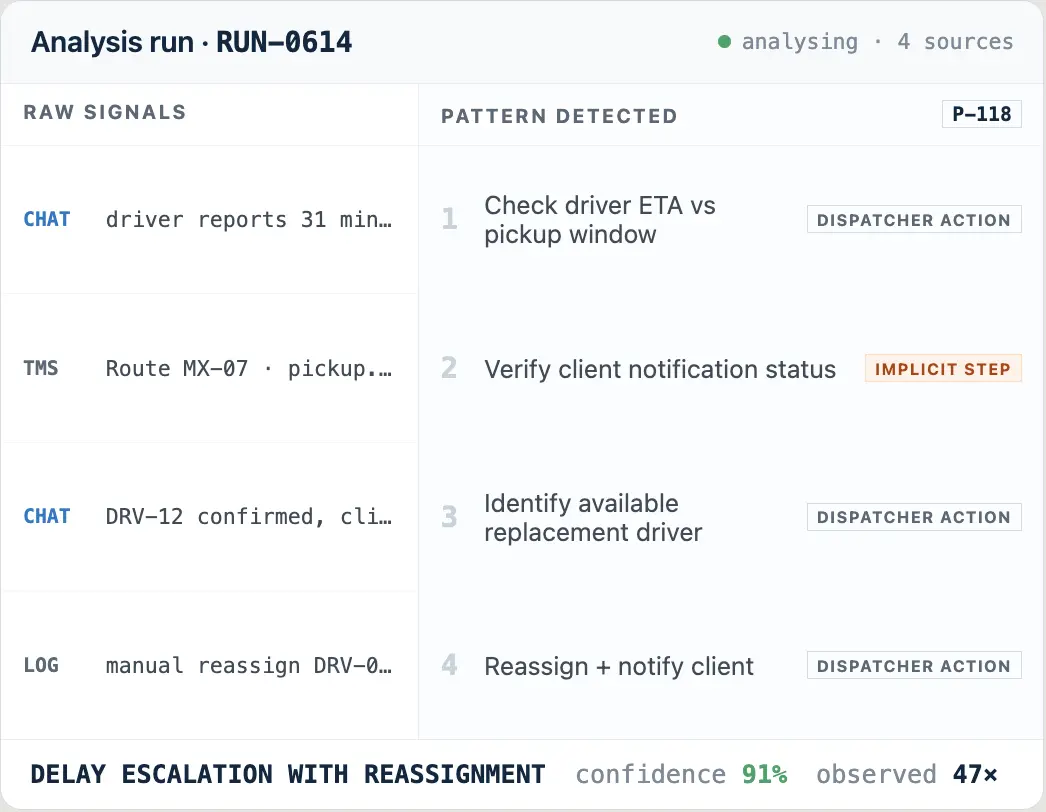
The platform analyses dispatcher screen recordings to extract real working patterns: the order of decisions, the hidden steps, and the context switches that never make it into any system. This is expertise that cannot be captured any other way.
Scenario Formalisation
Turn unstructured experience into company-owned logic.
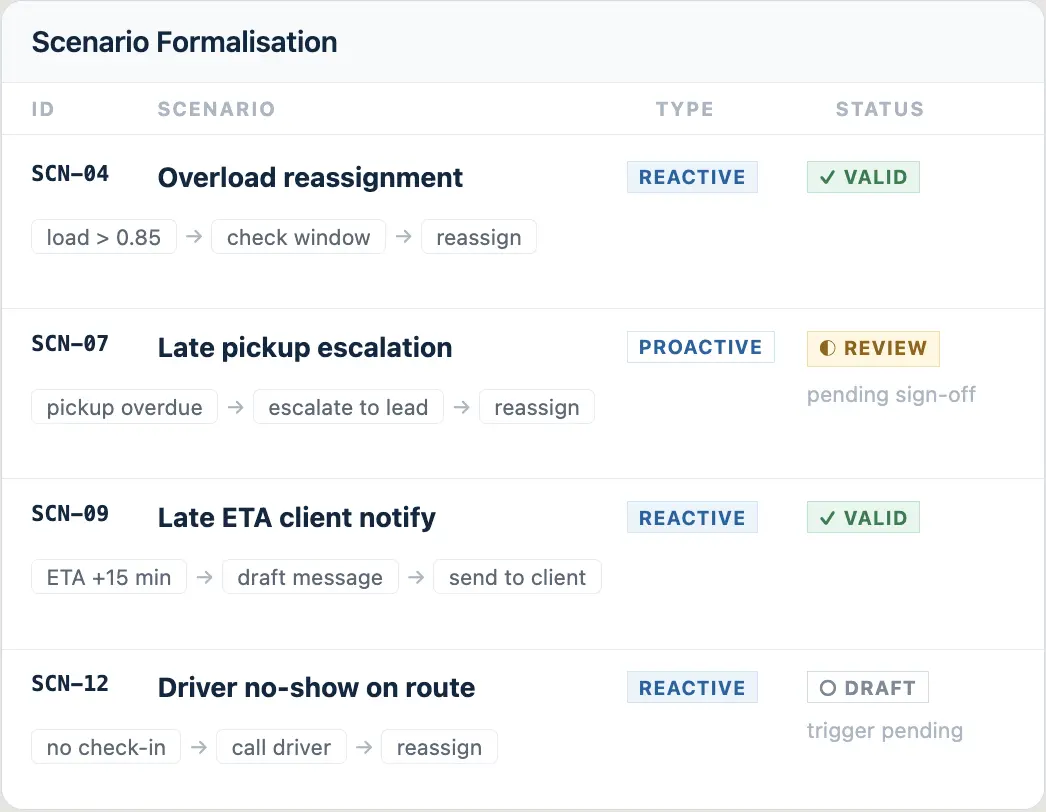
Identified patterns are decomposed into validated scenarios: reactive for incoming requests and proactive for trigger-based monitoring. Each scenario is reviewed with your experts before deployment.
Two Modes: Augmented & Autonomous
Choose the right level of automation for every scenario.
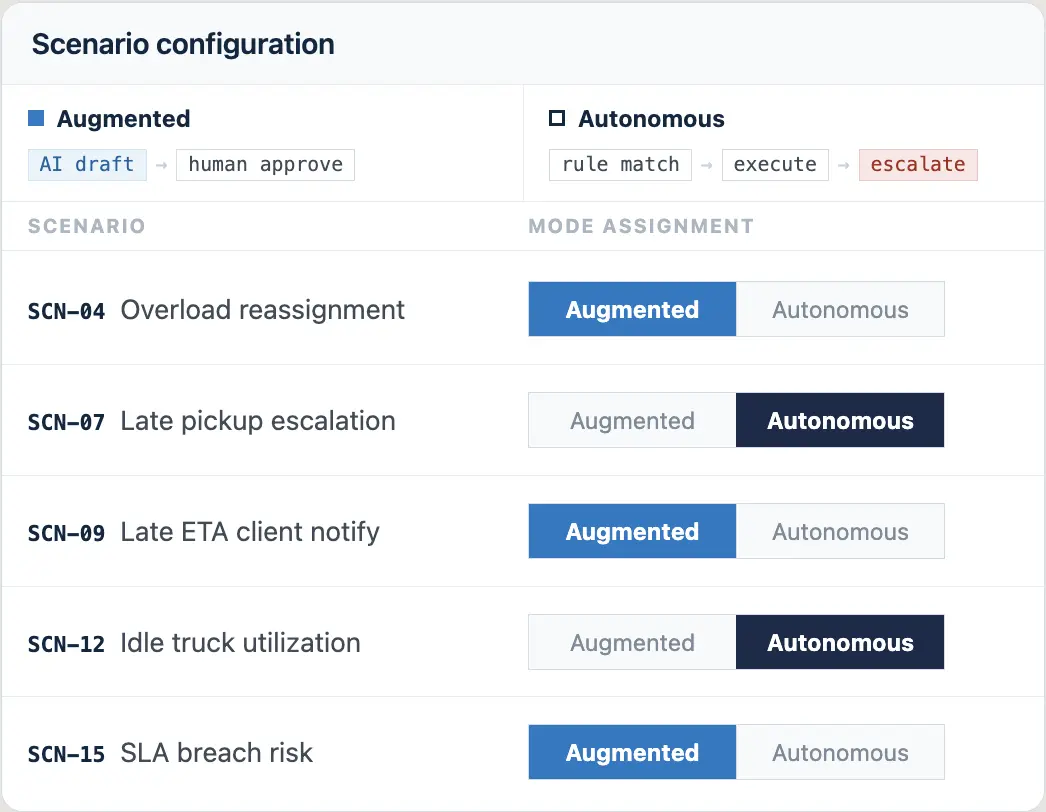
In Augmented mode, the AI prepares decisions for dispatcher approval, multiplying capacity without removing human judgement. In Autonomous mode, fully deterministic scenarios run without human involvement, with automatic escalation for any deviation.
The system catches problems before your dispatcher opens the screen
Digital Dispatcher continuously monitors active shipments for four categories of critical deviation. Each type has its own urgency level and triggers a specific action: from an informational alert to immediate escalation.
The shipment is behind schedule relative to the committed client SLA window. The system cross-references current driver position, distance, and road conditions, and signals in advance, not after the breach.
The driver began moving but has unexpectedly stopped. Without automated detection, the dispatcher discovers this at the next manual check. The system flags it immediately and prepares an escalation package.
The driver has not confirmed pickup within the expected window. The system detects the gap, checks last communication, and initiates verification, before the delay cascades into a missed delivery window.
The driver's physical location does not match their declared status. This requires immediate verification and is escalated with the driver's actual coordinates, last communication, and remaining SLA time.
From audit to scaled automation
Audit & Data Extraction
The agent analyses your team's chat history, call logs, and screen recordings to map real decision-making patterns — not what people say, but what they do.
Scenario Formalisation
Patterns are decomposed into scenarios with clear rules, reviewed and approved by your operations experts before any automation is deployed.
Deployment
AI agents connect to your communication channels, handling decisions, monitor SLA compliance, and prepare escalations with full context.
Scaling
One unified configuration model covers multiple clients and SLAs. A new client is a configuration, not a development project.
Outcomes that compound with every shift
Consistent quality, every shift
Every dispatcher works with the same digitised scenarios. The proper approach for every client and every route becomes the standard for all.
Errors caught before penalties
Proactive monitoring detects SLA risks before breach. The dispatcher intervenes in time, not after the loss.
Escalations with context, not a flag
Dispatchers receive deviation reason, location, SLA remainder, and a suggested action. They decide, not diagnose.
Independence from turnover
Expertise is formalised and owned by the company. A dispatcher leaving no longer means an operational crisis.
Scale faster & cheaper
Due to automation, one dispatcher manages what used to require five. Growing volume no longer requires proportional headcount growth.
New hires productive faster
New team members work alongside a system that already knows all key scenarios, and the time to full productivity drops significantly.
See the automation potential before you commit
We take one real workflow from your operation and formalise it into a validated digital scenario. You see exactly what the platform produces before any contract.
Request a Free PilotBuilt for operations where institutional knowledge runs the business
Your best dispatcher carries SLA logic for a dozen clients
Regional freight carriers and FTL/LTL operators where one resignation is an operational crisis. Digital Dispatcher captures that logic before the next one and scales it across your team.
You coordinate dozens of shipments across multiple SLAs
Freight forwarders and expeditors dealing with constant manual monitoring and firefighting. The agent tracks every shipment and signals deviations before they become issues.
Writing separate rules for every client doesn't scale
Operators managing multi-client environment. Digital Dispatcher uses a unified configuration model — one logic layer, per-client parameters for SLA thresholds and escalation levels.
Not another chatbot and an RPA script
| Criterion | Digital Dispatcher | Chatbots & RPA Tools |
|---|---|---|
| Knowledge capture | Extracts logic from screen recordings, chats, and calls | Requires manual rule definition by your team |
| Context awareness | Reads full conversation history; never asks a question already answered | Rigid triggers and timers with no memory |
| Anomaly detection | Monitors for SLA deviation, unexpected stops, status skips, location mismatch | No proactive monitoring; reacts only to explicit triggers |
| Escalation quality | Full context package: deviation reason, driver location, SLA remainder, suggested action | A flag on an order — dispatcher still has to diagnose |
| Scalability | One unified model covers multiple clients via configuration | Separate development required per client or workflow |
For agencies, integrators, and resellers
White Label Products
Resell AutoBooking under your own brand. Includes source code access, customisation capabilities, implementation support, and an enterprise-ready foundation.
Referral & Delivery
Bring opportunities from your network. Earn through revenue-sharing, referral commissions, and optional delivery involvement with engineering support behind you.
Consulting companies
Help clients modernize operations without building from scratch.
Automation agencies
Extend your service offering with ready-to-deploy products.
Software vendors
Add AI and logistics capabilities faster using White Label products.
System integrators
Deliver larger projects with experienced engineering support.
Industry advisors
Monetize your relationships through referral partnerships.
Common Questions
Capture your team expertise, formalise and scale it
Start with a pilot: we formalise one real scenario from your operation and show you what the platform produces. No obligation — you own the output regardless.